
Climbing his way to the top, one board at a time.
By Brian Hall
Ten years ago, Noah Flegel’s life revolved around a tow rope. Wakeboarding was the focus, the profession, and the metric by which success was measured. Training sessions were structured, competition schedules dictated travel, and progression meant landing the next trick. Today, that rope is just one thread in a much larger weave — one defined less by a single discipline and more by conditions, curiosity, and time spent moving with the water instead of against it.
“I used to be super focused on wakeboard competing and training,” Noah said. “But over the last five years especially, the shift has been into being more of an all-around waterman.”
For the now 28-year-old, that word “waterman” is not a title earned through accolades or social media clips. It’s a practical, almost utilitarian definition shaped by experience.
“To me, being a waterman means always being capable of taking advantage of the conditions,” Noah said. “If there’s wind, I can kite surf or wing foil. If there are waves, I can surf. If it’s flat and calm, I can dive or spearfish. The idea is being prepared for whatever the ocean gives you.”
That conditions-driven mindset has quietly reoriented his life. Surfing and foil boarding — or “foiling” — have become his preferred languages, not because they replace wakeboarding, but because they expand possibility. Foiling, in particular, unlocked days that once would have been written off. Windy afternoons, marginal swell, and in-between moments are now all suddenly playable.
“Foiling opened the door to so many days where you wouldn’t really want to surf,” he said. “But at the same time, surfing perfect waves is still the epitome of a good time.”
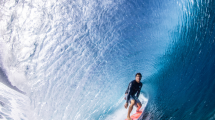
With that expansion of fun came a deeper relationship with fear. Ocean trips, especially to remote corners of the Bahamas, were heavy with anxiety. Stories of sharks, deep water, and unknown reefs kept him awake at night. Big-wave environments like the infamous Banzai “Pipeline” on Oahu’s North Shore and Jaws — a notoriously deadly break on the North Shore of Maui — demanded a recalibration of trust, both in the ocean and in himself.

“I’ve become a lot more comfortable with fear,” Noah said. “I’ve been in some really gnarly situations. Now I think back on those moments and tell myself, ‘I survived that. I can handle this.’”
That confidence is not swagger. It’s earned through experience, and tempered by realism. He’s quick to name the real danger in all of it: unconsciousness in the water. Near blackouts while diving and long hold-downs in heavy surf remain sharp reminders that progression always carries consequences.
Still, highlights rise above the fear. Surfing and recently foiling Jaws stand out as personal milestones, along with landing the world’s first strapless backflip on a foil in open ocean.
These moments weren’t chased for applause. “I just like pushing progression and having a good time,” he said.
As his relationship with the ocean has matured, another curiosity has surfaced. One that lives entirely on land: hunting, in which Noah finds an unexpected kinship with water sports.
“It’s like spearfishing or surfing,” Noah said. “You’re putting yourself in the right environment, waiting for the opportunity. The reward is different, but the process is similar.”
Where the ocean is dynamic and constantly moving, land demands patience. Long hours of stillness. Reading wind not for swell, but for scent. Learning migration patterns instead of currents.
“It’s slower,” he admits. “But it’s meditative. It teaches patience in a different way.”
That patience mirrors how Noah now approaches his days. There are no rigid routines, only phases. Stretching when his body asks for it. Training when motivation is high. Stepping back when it’s not. The one constant is water. “If I’m not in the water at least once a day, I start going a little stir crazy,” he said.

Ask him what advice he’d give someone 10 years younger, and the answer is refreshingly unpolished: Try new things. Learn from anyone with more experience. And above all, study the wind. Noah makes it clear: “I plan my week around the wind map. That’s what creates everything out there.”
It’s a fitting philosophy for someone whose growth hasn’t been linear, but expansive. Noah didn’t abandon wakeboarding, he built outward from it. Because being a waterman isn’t about mastery of one craft. It’s about readiness, respect, and knowing how to listen when the conditions speak.
@noahflegel